
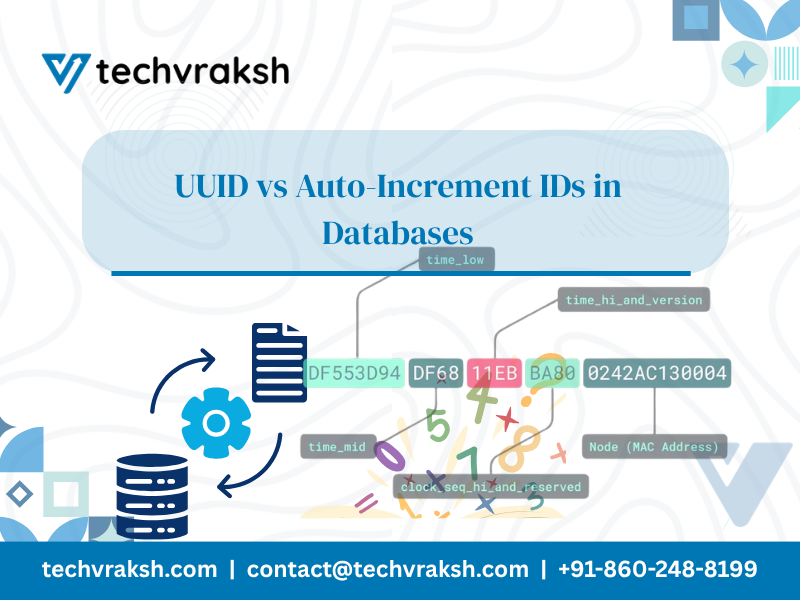
Choosing the right primary key strategy is a small decision that has a big impact on scalability, performance, and system design. Most developers default to auto-increment IDs. Others prefer UUIDs for flexibility and security. So which one should you use? The answer depends on your system architecture, scale, and long-term requirements. What Are Auto-Increment IDs…
Choosing the right primary key strategy is a small decision that has a big impact on scalability, performance, and system design.
Most developers default to auto-increment IDs. Others prefer UUIDs for flexibility and security.
So which one should you use?
The answer depends on your system architecture, scale, and long-term requirements.
What Are Auto-Increment IDs
Auto-increment IDs are sequential numeric values generated by the database.
Example:
1, 2, 3, 4, 5…
Characteristics:
- Simple and predictable
- Generated automatically by the database
- Efficient for indexing and querying
What Are UUIDs
UUID stands for Universally Unique Identifier.
Example:
550e8400-e29b-41d4-a716-446655440000
Characteristics:
- Globally unique
- Generated independently
- Not sequential
- Hard to guess
Core Difference
Auto-increment IDs are sequential and database-dependent.
UUIDs are globally unique and system-independent.
This difference affects performance, scalability, and security.
When to Use Auto-Increment IDs
Best For:
✔ Small to medium applications
✔ Single database systems
✔ Internal tools
✔ Systems where simplicity matters
Advantages
1. Performance
- Faster indexing
- Better cache locality
- Smaller storage size
2. Simplicity
- Easy to implement
- Easy to debug
- Predictable values
3. Efficient Joins
- Numeric keys are faster for joins
Limitations
❌ Hard to scale across distributed systems
❌ Predictable IDs can expose data patterns
❌ Not suitable for multi-region or multi-service systems
When to Use UUIDs
Best For:
✔ Distributed systems
✔ Microservices architecture
✔ Public APIs
✔ Systems requiring high security
Advantages
1. Global Uniqueness
- Can be generated anywhere
- No dependency on database
2. Better for Distributed Systems
- No collision across services
- Easy data merging across systems
3. Security
- Hard to guess
- Prevents ID enumeration attacks
Limitations
❌ Larger size (16 bytes vs 4 or 8 bytes)
❌ Slower indexing due to randomness
❌ Less human-readable
❌ Can cause database fragmentation
Performance Consideration
Auto-increment IDs:
✔ Faster inserts
✔ Better index performance
UUIDs:
❌ Random inserts cause index fragmentation
❌ Slightly slower queries
However, modern databases and optimized UUID versions reduce this gap.
Modern Approach: Optimized UUIDs
Not all UUIDs are equal.
Better Options:
- UUID v1 (time-based)
- UUID v7 (time-ordered, modern standard)
- ULID (sortable and readable alternative)
These provide:
✔ Better index performance
✔ Partial ordering
✔ Reduced fragmentation
Security Perspective
Auto-increment:
❌ Easy to guess
❌ Vulnerable to enumeration
UUID:
✔ Hard to predict
✔ Better for public-facing systems
If your IDs are exposed in URLs or APIs, UUIDs are safer.
Scalability Perspective
Auto-increment:
❌ Requires central coordination
❌ Difficult in distributed environments
UUID:
✔ Generated independently
✔ Ideal for microservices and multi-region systems
Hybrid Approach (Recommended in Many Cases)
Many modern systems use:
✔ Auto-increment internally for performance
✔ UUID externally for security
Example:
- Internal DB ID: 12345
- Public ID:
550e8400-e29b-41d4-a716-446655440000
This gives the best of both worlds.
Common Mistakes
❌ Using UUID without considering performance
❌ Using auto-increment in distributed systems
❌ Not indexing UUID properly
❌ Choosing based on trend instead of requirement
Quick Decision Guide
Choose Auto-Increment if:
- You have a single database
- Performance is critical
- Simplicity matters
Choose UUID if:
- You have distributed architecture
- Security is important
- IDs are exposed publicly
How TechVraksh Approaches ID Design
At TechVraksh, we:
✔ Evaluate system architecture before choosing
✔ Use UUIDs for scalable and distributed systems
✔ Optimize database performance with indexing strategies
✔ Apply hybrid models where needed
We focus on long-term maintainability, not just quick decisions.
Final Thoughts
There is no universal winner.
Auto-increment IDs are fast and simple.
UUIDs are flexible and scalable.
The right choice depends on your system’s future.
Because changing your ID strategy later is one of the hardest migrations you will ever do.